Woman Who Won Martial Arts in Disguise as a Man
 Edith Garrud demonstrating jujutsu techniques on a volunteer dressed as a police constable | |
| Focus | Self-defense |
|---|---|
| Hardness | Full contact |
| Land of origin |  United kingdom United kingdom |
| Famous practitioners | Edith Margaret Garrud, Phoebe Roberts |
| Ancestor arts | Jujitsu, Judo |
Suffrajitsu is a term used to describe the awarding of martial arts or cocky-defense techniques by members of the Women's Social and Political Marriage during 1913/14. The term derives from a portmanteau of Suffragette and Ju-jitsu and was commencement coined by an anonymous English journalist during March 1914.
During the Edwardian Period, jujutsu was promoted as a way to foster women's cocky defence, autonomy and health, initially in the United kingdom of great britain and northern ireland and and so elsewhere in the Western World.
In contemporary usage, "suffrajitsu" describes the suffragettes' techniques of visible 'cocky-defence, sabotage and subterfuge' against the police and other aggressors, whilst promoting the benefits of jujitsu every bit a 'free activeness' and a form of self-defense for dealing with both domestic violence in the home, and public attacks to women.[1] [ii]
Etymology [edit]
The term "suffragette" was first used in 1906 pejoratively past the journalist Charles E. Hands in the London Daily Mail describing female activists working for women's suffrage, in detail members of the WSPU. The latter, notwithstanding, embraced the term and used it to distinguish their own, radical and militant arroyo from that of more staid and police-abiding "suffragist" organisations such equally the National Union of Women'due south Suffrage Societies.
Martial arts instructor Edith Garrud believed the term "Ju-Jutsuffragettes" originated from Wellness & Forcefulness Magazine prior to 1910.[3]
The term 'Suffrajitsu' was coined by an anonymous English announcer in a widely-republished article first issued in March 1914 and has afterwards been re-popularised past the Suffrajitsu: Mrs. Pankhurst's Amazons graphic novel series (2015).
Style of engagement and contemporary influence [edit]
Suffrajitsu drew upon the techniques of the Japanese jujutsu teachers in London during the Edwardian menses. Women in particular were seen equally ideal to appoint in Jujitsu, as their smaller on boilerplate builds allowed them an advantage in allowing their opponent to underestimate them based on their being the 'fairer/weaker' sex and then using their jujitsu to topple larger opponents.
Exterior of the preparation suffragettes received related to ju-jitsu, weapons were likewise frequently taken into account by their practicality, to prevent attack on their persons, both domestically and past the police. Members of the WSPU Bodyguard (see below) were issued with Indian clubs for use every bit weapons. Women learned to defend themselves with everyday items of clothing such as the Hatpin, used by Edwardian women to concord their oversized hats in place which could at times reach up to 16 inches in length, either to disarm or maim. Flora Drummond, known equally 'The General' for wearing a war machine manner compatible, Helen Ogston, Teresa Billington-Greig and Maud Arncliffe Sennett were each known to carry around whips, to intimidate opponents.[2] At the Battle of Glasgow (1914), suffragettes engaged with police by deploying hidden spinous wire as a stalling tactic.[4]
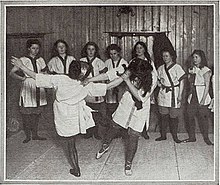
History [edit]
Ju-jitsu was first demonstrated in London in 1892 by Tetsujiro Shidachi and later promoted in England by the Bartitsu founder and practitioner Edward Barton-Wright, who introduced Asian martial arts to the middle-classes between 1899–1902. Unusually for Edwardian-era "antagonistics" (combat sports) clubs, lessons at the Bartitsu Club were available to women as well as men.
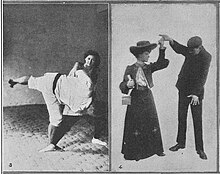
In the interest of women practitioners and writing in the Daily Mirror in 1903, Evelyn Abrupt called for 'women [to] take the special ladies classes offered by (quondam Bartitsu Club teacher Sadakazu) Uyenishi in Golden Square'. The specific classes being offered taught past Emily Diana Watts; who herself learnt from preparation at the Oxford Street dojo of Uyenishi's sometime associate Yukio Tani, along with other 'lady instructors' like Phoebe Roberts (1887–1937) who also taught Judo alongside Uyenishi past December 1904 at the Golden Square school. Uyenishi, remarking on woman learning ju-jitsu, was quoted as noting that "Balance and quickness will always win, and women are always quick." [5] Coupled with the heightened position of Nihon equally a nation state after the Anglo-Japanese Alliance and the victory over Russian federation in 1905 based partly on the word of the Japanese ground forces claiming Judo was their secret weapon and hyperbolic claims of jujutsu teachers and sportswriters, at that place was an inclination in Edwardian English club to larn near 'jiu-jitsu', and the art was taught to young women at Girton College and Newnham College.[half-dozen] [7] [8]
By 1905 Watts began teaching self-defence lessons to other high society women such as Duchess Bedford and by 1906 began teaching Jujitsu classes at the Princes Skating Club, Knightsbridge, also publishing The Fine Art of Jujutsu. Other female students of this style included Marie Studholme who trained under Tani in 1907.[ix] Ju-jitsu parties became all the rage, instructing upper and centre grade in the art of cocky-defence force in their homes, or at afternoon tea.[4]
In 1908, Edith Garrud took over women'due south classes at the Gold Square School when Uyenishi left England. Garrud besides founded the 'Suffragettes Self-Defense Club' in 1909, a suffragettes-only Jujutsu club, which from 1911 moved to the Palladium Academy, in Argyll Street.
The requirement for suffragette self-defence was reinforced by events such as the Black Friday Raid, wherein plain clothes law officers had allegedly physically and sexually assaulted unarmed women attempting to force entry to the House of Commons during a "Raid on Parliament" protestation action.[10]
Even later on the dissolution of the more violent tactics used past the WSPU in 1914, in 1918 when Christabel Pankhurst was running for office for the Smethwick seat at the General Election, her supporters used jujutsu to deter protestors rallying against her running for the seat.[xi] With the founding of the Budokwai in 1918, Jujitsu and Judo began to attain non-political and international followings and were increasingly taught once over again primarily equally sport or for self-defence. The first female person practitioner, Katherine White-Cooper, entering the Budokwai in April 1919.[9]
Recreational Action or 'The Soft-Art' [edit]

Jujitsu was promoted as a way not only to assistance defend women but to for their mental and physical health and well-being. The suffragette movement (like the feminist movement to other contact and non-violent sport later on[12]) promoted its recreational usage;[4] The 1908 lath game Suffragetto introduced a then-highly political topic into the domestic sphere, framing and engaging the consequence in a more positive light for a wider audience.[13] In this manner, self-defence could be marketed equally a sport, hobby or entertainment rather than being pejoratively labelled by the wider society equally an aggressive or niche activity for women. Performers and publicists like the strongman Eugen Sandow, promoted Jujitsu for women in his magazine on physical culture as a form of 'rational practise' which supported 'feminine grace'.[14] [15] Given a heightened interest in national wellness due to a national report revealing health issues in the Uk, it was also in the national involvement to increase public participation in sport. Indeed, in 1913 Edith Garrud'southward dojo was used as a base for militant suffragettes fleeing from pursuing policemen; hiding their protest implements and changing into Jujitsu uniforms gave them the veneer of respectable sportswomen.[7]
Promotion through the Arts [edit]
I mode of promoting Jiu-jitsu to the public was through theatre productions incorporating the mode, with female participants performing and demonstrating the style'due south particular benefits when 'a light slim girl ... was able to throw heavy male opponents with the utmost ease.' In 1904, Roberts and Watts performed with Tani and Uyenishi at Caxton Hall to promote the style, in the guise of phase entertainment, Roberts later performing for the Nihon Society in 1906 at the Kew, Regents Park and in 1908 at the Palace Theatre, Manchester. Roberts eventually toured Barcelona demonstrating Jujitsu for female audiences.[7]
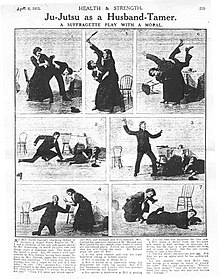
Ju-Jutsu as a Married man-Tamer (1911)
Garrud demonstrated Jujitsu for the WSPU in 1909, and in January 1911 choreographed the fight scenes for the play What Every Adult female Ought to Know. In August Garrud wrote almost using Jiu-jitsu as a grade of cocky-defence in Wellness and Strength magazine. [16]
"ju-jutsu has over and over again been proved to be the most effective means, ... because information technology is piece of cake to learn, and because it is, quite apart from its combative value, a splendid exercise; information technology is the very thing for women besides as men to have up thoroughly." —Edith Garrud, July 23, 1910
Filmography [edit]
| Title | Company | Year |
|---|---|---|
| Jiu-jitsu Downs the Footpads | Pathé | 1907 – in which a woman played by jujutsu teacher Edith Garrud is pursued by 2 "ruffians" and ultimately defeats both of them with her martial arts skills |
| Charley Smiler Takes Up Ju-jitsu | Pathé | 1911 – features a sequence in which the protagonist is defeated past "Miss U.I. Throwe" in a jujutsu match, after which she hands him a calling carte reading "Votes for Women!" |
Militancy in WSPU and The Bodyguard [edit]
Jujitsu was initially demonstrated and promoted as a manner of self-defense force, just subsequently the death of women like Mary Jane Clarke and the Conciliation Bills fiasco, the WSPU began to employ more militant forms of protestation such equally midnight raids on parliamentarians homes besides as nationwide arson and bombing campaigns, albeit the latter two categories of activity were only carried out confronting unoccupied properties.[17]
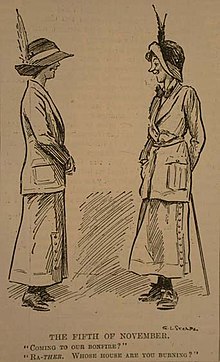
Dial Cartoon depicting militant suffragettes
In response to the Cat and Mouse Act of 1913, the WSPU formed what was termed variously the 'Bodyguard', 'Jiujitsusuffragettes' or 'Amazons'; a grouping of about xxx suffragettes tasked with protecting suffragettes who had been released from hunger hit in prison from being re-arrested. In order to be eligible to serve with the Bodyguard, women had to be in practiced physical condition, trained in self-defence and willing to risk their rubber and freedom in service of their cause. The arrangement engaged Edith Garrud to teach them how to forbid bodily impairment against themselves from the police.
Agile members of the Bodyguard employed hand-to-mitt combat when necessary to protect their charges, merely by preference employed techniques of lark, evasion and misdirection in collaboration with the big, semi-underground network of WSPU sympathisers.
The Bodyguards' most well known manus-to-hand combats engagements with police officers were the "Battle of Glasgow" on 9 March 1914, during which about 30 Bodyguards battled a much larger contingent of constabulary constables and detectives on the stage of St. Andrew's Hall before a shocked audience of some 4500 people, and during their "Raid on Buckingham Palace" on 24 May 1914, when club-wielding suffragette Bodyguards fought constabulary in the streets while attempting to access Buckingham Palace and present a suffrage petition to Male monarch George.
The Bodyguard grouping was disbanded shortly after England declared state of war confronting Frg at the commencement of the First Earth War, because the WSPU no longer required protection when they discontinued their militant activism and instead turned to supporting the war efforts.
| Name | Background |
|---|---|
| Gertrude Harding | Head of Bodyguards, Jujitsu |
| Kitty Marshall | Jujitsu |
| Edith Garrud | Trainer for bodyguards, Jujitsu |
Representations in modern popular civilization [edit]
The Suffrajitsu miracle has been portrayed in a variety of mod media including:
- The 2015 graphic novel trilogy Suffrajitsu: Mrs. Pankhurst's Amazons
- The 2015 feature pic Suffragette, which includes a brief scene in which radical suffragette Edith Ellyn (Helena Bonham Carter) teaches a self-defence grade
- Season 3, Episode 5 of the Drunk History (UK) TV comedy show (2017) features a Suffrajitsu segment starring Jessica Hynes as Emmeline Pankhurst
- The 2018 independent documentary No Man Shall Protect U.s.a.: the Hidden History of the Suffragette Bodyguards
- Season 5, Episode v of the Drunk History (U.s.) comedy TV evidence (2019) features a Suffrajitsu segment starring Tatiana Maslany as Emmeline Pankhurst and Kat Dennings as Babysitter Gertrude Harding
- The 2020 Netflix movie Enola Holmes starring Millie Bobby Brown in the title office as a martial arts-trained detective in Edwardian London, co-starring Helena Bonham Carter as her radical suffragette/martial artist female parent and Susie Wokoma every bit jujutsu trainer Edith Grayston.
United States [edit]
In the United States, Japanese instructors such as Yae Kichi Yabe in Rochester, New York began educational activity jiu-jitsu to Americans. Women recognized that jiu-jitsu training was not only effective every bit a means of self-defense force but had political implications as well. President Theodore Roosevelt was a song abet of jiu-jitsu training as a way of fostering manliness in American men and preparing United States soldiers for battle. In 1904, Roosevelt hired jiu-jitsu instructor Yoshitsugu Yamashita to train him in the Japanese art of self-defense force and made a public display of his training for the press.[18] [xix] Feminists annoyed by the posturing of men similar Roosevelt, insisted that women were but as capable of learning jiu-jitsu. To prove their point, Martha Blow Wadsworth and Maria Louise ("Hallie") Davis Elkins hired Fude Yamashita, a highly skilled jiu-jitsu instructor and the wife of Yoshiaki Yamashita, to teach a jiu-jitsu class for women and girls in Washington, DC in 1904. The participants of the course included Grace Davis Lee, Katherine Elkins, Jessie Ames, and Re Lewis Smith Wilmer.[9]
Also in 1904 the Physical Training for Women book was released past announcer H. Irving Hancock, based on the Tsutsumi Hōzan-ryū style. The work whilst simply showing basic partnered stretches, was taken up for cocky-defense confronting 'mashers',[20] with journalist Priscilla Leonard writing how Hancock relayed that 'In Japan the women are not weaker, and in this country they accept no right to be [either]'.
American suffragists drew inspiration from the tactics of the British militant suffragettes. Some American women directly participated in the actions initiated by the WSPU and a few even became members of the Bodyguard. Chicago reformer Zelie Emerson was recruited to join the movement past Sylvia Pankhurst who was on a speaking tour in the United States at the time. In 1913, Emerson traveled back to the Uk with Pankhurst and was arrested multiple times for breaking windows to advocate votes for women. Emerson was arrested, sent to prison, and went on hunger-strike. Later directly experiencing police brutality and having her skull fractured by police truncheons on two carve up occasions, Emerson decided to join the suffragettes in drilling in the use of clubs, battle, and jiu-jitsu.[eighteen]
Most American suffragists tried to avoid any clan with the militant tactics of the British suffragettes. There was no formal organization like the Bodyguard amid suffragists in the Usa. Yet, according to historian Wendy Rouse who has studied the origins of the women's self-defense movement in the United States, some American suffragists did advocate cocky-defense training for women and some groups of suffragists organized small groups to train in secret. Specially afterwards their direct experiences with violence in the 1913 women's suffrage parade, American suffragists recognized that the constabulary would offer them little protection. They began to recognize the value of jiu-jitsu training for their ain self-defense.[18] New York suffragist Sofia Loebinger told reporters that she admired the British suffragettes who practiced jiu-jitsu: "Strong situations need strong women, and I am heartily in favor of the movement." She expressed the conventionalities that "battle would be a skillful matter for women if only to teach them to concentrate their minds on one thing at a fourth dimension. The ballot, for instance."[21]

In 1918, American gild likewise began to promote Judo and wrestling as being fit for women's self-defense against the 'mashers' rather than a 'masculine' sport like battle, with organizations like the Immature Women'due south Christian Association (YWCA) promoting the sports. Women's Judo in Hawaii particularly flourished, with Hilo promoter Miss Harrison, and with Maui promoters including Floy Robinson, Kennette Griffith, Myrtle Nelson, Emma Cawdry, and Elva Class and the first female black belts including Shizuko Murasaki, Matsue Honda, and Yasue Kuniwake. Suffragettes and upper-class socialites oft viewed learning martial arts as engaging in female empowerment, dissimilar battle whilst working grade women used combat sports, mostly wrestling in vaudeville productions and self-defence where necessary. However almost women until the 1940'due south viewed learning jiu-jitsu as 'manly', something which could scare off prospective marriage partners if the women built up too much muscle, diminishing their 'figures' and 'womanly charms'.[9]
Farther reading [edit]
- Meine Selbsthilfe Jiu Jitsu für Damen (My Selfhelp Jiu Jitsu for Women), Attinger (1901)
- Concrete Training for Women by Japanese Methods, M.P. Putnam'southward Sons (1904)
- The Fine Art of Jujitsu, William Heinemann & Co (1906)
- The Life and Adventures of Miss Florence LeMar, the World'south Famous Ju-Jitsu Daughter, Florence leMar (1913)
- Suffragette Escapes and Adventures, Katherine "Kitty" Marshall (Unpublished, 1947)
Run into also [edit]
- Sarah Mayer
- Emily Diana Watts
- Edward William Barton-Wright
- Judo in the Britain
References [edit]
- ^ "Journal of Non-lethal Combat: Damsel v. Desperado". Archived from the original on 24 July 2008.
- ^ a b "Jujitsu suffragettes". HistoryExtra . Retrieved eighteen January 2021.
- ^ "Periodical of Non-lethal Combat: Damsel v. Desperado". 24 July 2008. Archived from the original on 24 July 2008. Retrieved 23 November 2021.
- ^ a b c McEachern, Megan. "Suffra-jiu-jitsu: New exhibition sheds calorie-free on little known facts nigh Scotland's suffragettes". The Sunday Postal service . Retrieved 23 November 2021.
- ^ The War in the Far East, The Times, 12 May 1904, p. nine
- ^ Delap, Lucy; DiCenzo, Maria; Ryan, Leila (2006). Feminism and the Periodical Press, 1900-1918. Taylor & Francis. ISBN978-0-415-32027-6.
- ^ a b c Twentieth-Century: The Cases of Phoebe Roberts, Edith Garrud, and Sarah Mayer, Mike Callan, Conor Heffernan, Amanda Spenn, The International Journal of the History of Sport, Book 35, Outcome 6: New Historical Work on Women and Gender, 2018, pp. 530–553
- ^ "InYo: Women Who Would Not be Sheep". Archived from the original on 2 September 2009.
- ^ a b c d "InYo: Women's judo 1900–1945; Svinth". Archived from the original on ten February 2009.
- ^ "Martial History Magazine | Jujutsu Suffragettes". 21 November 2008. Archived from the original on 21 November 2008. Retrieved 18 Jan 2021.
- ^ Christabel Pankhurst and the Smethwick Election: Right-Wing Feminism, the Great War and the Ideology of Consumption,Nicoletta F. Gullace, Women's History Review, 23, No.three, June 2014, p. 336
- ^ See Real Knockouts: The Physical Feminism of Women'southward Cocky-Defence, Martha McCaughey, 1997 and Barbara Deming, Revolution and Equilibrium, 1971
- ^ says, Gina Pacington scott. ""Suffragetto": a Suffragettes vs. Police Board Game Rediscovered Later on 100 Years | Suffrajitsu". Retrieved 18 January 2021.
- ^ The Perfect Human being: The Muscular Life and Times of Eugen Sandow, Victorian Strongman, David Waller, 2011, p. 132
- ^ "InYo: Jiu-Jitsu for women, Sandow's Magazine". ejmas.com . Retrieved 18 January 2021.
- ^ "rhetorically speaking..: kidney-punching the patriarchy". 18 July 2007. Archived from the original on eighteen July 2007. Retrieved 18 January 2021.
- ^ "The 1910s: 'We have sanitised our history of the suffragettes'". the Guardian. 6 February 2018. Retrieved xviii January 2021.
- ^ a b c Rouse, Wendy (2017). Her Own Hero: The Origins of the Women'due south Self-Defence Movement. New York: New York University Press. ISBN978-1479807291.
- ^ Rouse, Wendy (2015). "Jiu-Jitsuing Uncle Sam: The Unmanly Art of Jiu-Jitsu and the Yellow Peril Threat in the Progressive Era United States". Pacific Historical Review. 84: 448–477. doi:x.1525/phr.2015.84.four.448.
- ^ A slang term in use from 1872, being a man who makes indecent sexual advances towards women, peculiarly in public places. OED online
- ^ Greeley-Smith, Nixola (11 April 1911). "Suffragettes Will Cultivate Muscles and Fight Like Amazons for Her Ballot". Evening World. New York. p. 3.
{{cite news}}: CS1 maint: url-status (link)
External links [edit]
- suffrajitsu
.com : promotional website for the Suffrajitsu graphic novel trilogy, with historical information on the real-life Babysitter squad that inspired the fiction
Source: https://en.wikipedia.org/wiki/Suffrajitsu
0 Response to "Woman Who Won Martial Arts in Disguise as a Man"
Post a Comment